Sunday, 6 October 2013

Tolkien Transactions XLI

September 2013

This has been a great month! I've been as busy as never before, first with trying (and failing) to finish all my various projects before starting the new job and then getting into speed at the new job. I do hope that the lateness of my transactions is not going to be a standard fixture, but it has been very difficult to find the time to finish them this month — actually I am not sure that they are finished, but I need to get them out today, or it will be at least another week before I can finish them ...

All the usual disclaimers apply about newness, completeness and relevance (or any other implication of responsibility) :-) but this time the disclaimer about completeness should be stressed a bit more — this is what I have at this time, and I need to get it out today: if you know of other stuff, then please share in answers.

These transactions are posted to the usenet newsgroups rec.arts.books.tolkien, alt.fan.tolkien, and alt.books.inklings, and the usenet version can be accessed at http://www.webuse.net/frameset.php?su=newsgroup.php&ng=rec.arts.books.tolkien
These transactions are also posted on my blog, Parma-kenta (Enquiry into the books): http://parmarkenta.blogspot.com
and on LotR Fanatics Plaza in the books forum: http://www.lotrplaza.com/forumdisplay.php?14-The-Books

This month it has suited my purposes to sort the contents under the following headlines:
1: News
2: Essays and Scholarship
3: Commentary
4: Reviews and Book News
5: Interviews
6: Tolkienian Artwork
7: Other Stuff
8: Web Sites
9: The Blog Roll
10: Sources
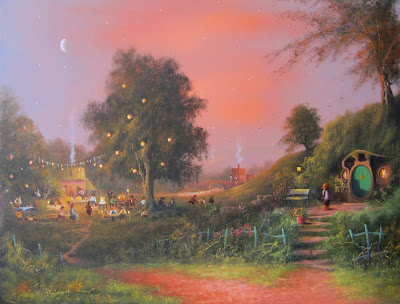
"Bilbo's Eleventy-First Birthday (The Party Tree)" by Joe Gilronan
Bilbo's Eleventy-First Birthday (The Party Tree)
by Joe Gilronan

= = = = News = = = =

Hungarian Tolkien Society, Sunday, 1 September 2013, ‘TLV Goes International!’
http://tolkien.hu/index.php?option=com_thcm&categoryId=205&contentType=NEWS&contentId=2905&Itemid=205
http://preview.tinyurl.com/o9kewnu
The Hungarian Tolkien Society, Magyar Tolkien Társaság, has, for the past seven years, held an annual mail-based competition on Tolkien topics, the TLV, Tolkien Levelezo Verseny. This year, they have decided to add an international category open for contestants between 15 and 35. So, if you have managed to sign up in time, it will be an excellent opportunity to test your Tolkien mettle.
See also MB, Tuesday, 10 September 2013, ‘Tolkien Mailing Competition goes international’
http://www.thetolkienist.com/2013/09/10/tolkien-mailing-competition-goes-international/
http://preview.tinyurl.com/pkn4xe2

Zoe Hinchliffe, Brisbane Times, Monday, 2 September 2013, ‘Tolkien fans invited to Middle Earth [sic]’
http://www.brisbanetimes.com.au/queensland/tolkien-fans-invited-to-middle-earth-20130901-2sygb.html
http://preview.tinyurl.com/o5d74el
The Brisbane Tolkien Fellowship, with coordinator Fortinbras Proudfoot, Esq. (a.k.a. Peter Kenny) is inviting Tolkien enthusiasts and fans and other interested parties to an evening in Middle-earth in favour of the Pyjama Foundation charity. Good luck with the fund-raising!

The Telegraph, Monday, 2 September 2013, ‘On the Tolkien trail’
http://www.telegraph.co.uk/travel/picturegalleries/10280630/On-the-Tolkien-trail.html?frame=2659282
http://preview.tinyurl.com/pyuhaen
A very nice picture gallery of Tolkien-related places including many of the places where Tolkien lived (though it also includes some of the more dubious ‘usual suspects’ such as Perrot's Folly and the Edgbaston Waterworks' Victorian chimney).

MB, Monday, 16 September 2013, ‘'There's an eye opener, and no mistake' — Greisinger Museum opened’
http://www.thetolkienist.com/2013/09/16/theres-an-eye-opener-and-no-mistake-greisinger-museum-eroffnet/
http://preview.tinyurl.com/nnfx74g
Congratulations to the Greisinger Musem!
The Greisinger Museum opened in the weekend of the 7-8 September in Jenins, Switzerland, with a great gathering of Tolkien enthusiasts. I would have loved to join the festivities, but will have to do with Marcel's report and putting Jenins on my list of places to visit before too long.
See also John di Bartholo, ‘Greisinger Museum Opening Ceremony’
http://legendarium.mymiddleearth.com/2013/09/11/greisinger-museum-opening-ceremony-part-1/
http://preview.tinyurl.com/pgq8zvs

MB, Tuesday, 24 September 2013, ‘Readings and radio plays & rumours of an unpublished Tolkien speech’
http://www.thetolkienist.com/2013/09/24/readings-and-radio-plays-rumours-of-an-unpublished-tolkien-speech/
http://preview.tinyurl.com/ntmb3wx
Marcel Aubron-Bülles announces a new series on his Tolkienist blog that will review various audio dramatizations (including readings) of Tolkien's works, and incidentally also mentions the existence of recordings of the Tolkiens and the possibility of hitherto unknown recordings ...

Tunggul Wirajuda, Friday, 27 September 2013, ‘Tolkien Society Brings Middle Earth to Life at Jakarta Event’
http://www.thejakartaglobe.com/features/tolkien-society-brings-middle-earth-to-life-at-jakarta-event/
http://preview.tinyurl.com/pabmyjx
A report from the tenth anniversary party, of course named ‘A Long Expected Party’, of the Eorlingas — the Indonesian Tolkien Society. Congratulations to the Eorlingas!

= = = = Essays and Scholarship = = = =

Michael McCaughan, Material History Review, Tuesday, 3 September 2013, ‘Voyagers in the Vault of Heaven: The Phenomenon of Ships in the Sky in Medieval Ireland and Beyond’
http://www.medievalists.net/2013/09/03/voyagers-in-the-vault-of-heaven-the-phenomenon-of-ships-in-the-sky-in-medieval-ireland-and-beyond/
http://preview.tinyurl.com/n75hdk3
Though I am NOT suggesting any source relations, I could certainly not help but think ‘Éala Éarendel engla beorhtast ofer middangeard monnum sended’ when reading this bit from the abstract: ‘This paper explores the phenomenon of ships voyaging in the sky. Such fantastical sightings are considered primarily in an early medieval Irish context, but evidence from places as widely separated in time and place as thirteenth-century England and eighteenth-century Canada is also addressed.’

Ayesha Raza, Friday, 6 September 2013, ‘Bodies, Saracen giants, and the medieval romance : transgression, difference, and assimilation’
http://www.medievalists.net/2013/09/06/bodies-saracen-giants-and-the-medieval-romance-transgression-difference-and-assimilation/
http://preview.tinyurl.com/plmwsny
The giants and the medieval romances in the title of this 2012 Master's thesis from the Université de Montréal caught my eye (it has been said that Tolkien's The Lord of the Rings in genre terms in many ways is closer to the medieval romance than to the modern fantastic novel). I have scanned the introduction and the conclusion of the thesis, and the applicability for students of Tolkien may be limited, but I still thought it worth mentioning here.

James H. Barrett, Thursday, 12 September 2013, ‘What caused the Viking Age?’
http://www.medievalists.net/2013/09/12/what-caused-the-viking-age/
In this arcticle from Antiquity, Vol.82 No.317 (2008), James H. Barrett discusses the underlying socio-economic causes for the militant / mercantile expansion known as the Viking Age. There is of course no way that I would not find this interesting ;-)

http://www.medievalists.net/category/articles/
In addition to the above, there have been a large number of interesting-looking articles on Medievalist.net in September — some of them clearly related to research that Tolkien would have found interesting, on subjects that he worked with professionally, or on subjects that were clearly inspirations for Tolkien's work. As explained above, I have not had time to read anywhere near as much as I would have liked this month, so I haven't read these, but I'll mention a few headlines such as
‘Bone-Hard Evidence’ (15 Sep) asking the question ‘Raging marauders or heroic warriors? What were the Vikings really like?’,
‘Oaths in The Battle of Maldon’ (16 Sep),
‘When Witches Communed with Fairies’ (20 Sep),
‘Creating the Christian Anglo-Saxon and the Other in the Old English Judith and Beowulf’ (21 Sep),
‘The Dragon of the North: The Supernatural Nature of Knowledge in Voluspá’ (21 Sep),
‘Time, consciousness and narrative play in late Medieval secular dream poetry and framed narratives’ (26 Sep),
‘An Examination of the Family in 'The Tale of Sir Gareth'’ (27 Sep),
‘The Serpent in the Sword: Pattern-welding in Early Medieval Swords’ (28 Sep).
‘Snorri's Trollwives’ (29 Sep),
You'll see the point, I am sure :-)

John Garth, Friday, 27 September 2013, ‘Tolkien and the boy who didn't believe in fairies’
http://www.johngarth.co.uk/php/boy_didnt_believe_fairies.php
http://preview.tinyurl.com/ps9qrt8
John Garth's paper from Tolkien Studies 7 is here published on-line. David Bratman wrote about it, ‘I have never read a scholarly paper that left me more thoroughly charmed than John Garth's on Tolkien and Hugh Gilson,’ which is far better said than my own terse summary of the contents from my review in Mallorn: ‘John Garth explains that R.Q. Gilson's younger half-brother, Hugh Cary Gilson was the boy Tolkien spoke of in an anecdote in his drafts for ‘On Fairy-Stories’, and in J.R.R. Tolkien and the Boy Who Didn't Believe in Fairies' Garth gives both the evidence and some further information.’ Go read!

= = = = Commentary = = = =

BC, Monday, 2 September 2013, ‘Provenance of the Notion Club Papers - both fictional and true’
http://notionclubpapers.blogspot.dk/2013/09/provenance-of-notion-club-papers-both.html
http://preview.tinyurl.com/oflm95o
One of the most interesting blog entries by Bruce Charlton for quite a while. Charlton discusses the provenance of Tolkien's Notion Club Papers, particularly the curious way Tolkien (with great skill, I might add) manages to land somewhere between historical and fictional by suggesting both.

James Dunning, Wednesday, 4 September 2013, ‘A passport to Faery’
http://www.tolkienlibrary.com/press/1101-a-passport-to-faery.php
A curious essay on Tolkien's Faëry and the traveller therein. I am not entirely sure what to make of this — Dunning appears to have something he wishes to say, but I am not entirely sure what it is.

Leslie, Friday, 6 September 2013, ‘Wagner's Influence on: J.R.R. Tolkien’
http://wagnertripping.blogspot.dk/2013/09/wagners-influence-on-jrr-tolkien.html
http://preview.tinyurl.com/plr5m2z
An interesting take on the influence of Wagner on Tolkien's The Lord of the Rings focusing on the transition from Andvari's cursed ring (with no particular influence on the later plot) to Alberich's powerful ring in Wagner's Ring-cycle, and on the transition from Bilbo's simple ring of invisibility to the One Ring. I quite agree that the transition of Tolkien's ring is inspired or influenced by Wagner's ring, though I think Shippey nails it when he calls it a negative influence: Tolkien wanted to do better. We should not forget that Tolkien, as far as we know, only ever saw and heard one of the operas in Wagner's Ring-cycle, and this was after he had read all of them — Wagner's work, I am told (even by some who love it) is distinctly unimpressive when merely read like that, and what little I have read strikes me as being very poor sub-creation (Renée Vink interestingly suggests that Wagner's mode of sub-creation is the music, which seems to me a very reasonable suggestion — as far as we know, however, Tolkien only experienced the music of one of the Ring-cycle operas). I am sure that much work can still be done on comparing Wagner and Tolkien, e.g. on shared influences and shared themes, but as far as Wagner's influence on Tolkien's work is concerned, I believe that everything relevant is said in the above.

MM, Monday, 16 September 2013, ‘Why Does Tolkien's World Lack Women?’
http://middle-earth.xenite.org/2013/09/16/why-does-tolkiens-world-lack-women/
http://preview.tinyurl.com/peja6sz
Well said! Michael Martinez here rejects both the most common criticisms against the representation of women in Tolkien's works and the standard knee-jerk reactions of many fans. The point, as Martinez also concludes, is that there are no, or very few, realistic women in Tolkien's work (at least among those who are more than a quick sketch such as Rose Cotton). With a Mythopoeic Society collection on women in Tolkien's works putting the issue on the more serious critical agenda, it is good to see a considered, and relatively brief, statement such as this.

Lyn Forest-Hill, Monday, 16 September 2013, ‘September: First Meeting’
http://southfarthingmathom2012.wordpress.com/2013/09/16/september-first-meeting/
http://preview.tinyurl.com/nmsx834
The Southampton Tolkien Reading Group (Southfarthing Smial) continues with Garth's Tolkien and the Great War, this time chapters 11 and 12, with a bit more than the usual detours. As always the discussions are full of insights and interesting perspectives.

MM, Wednesday, 25 September 2013, ‘How Much Was J.R.R. Tolkien Influenced by Wagner's Ring Cycle?’
http://middle-earth.xenite.org/2013/09/25/how-much-was-j-r-r-tolkien-influenced-by-wagners-ring-cycle/
http://preview.tinyurl.com/qx6qh76
I cannot go the whole way with Michael Martinez in this question, but he has some very perceptive insights, including the point that elements of the transition of Bilbo's ring to the Master Ring borrow from the Silmarils. As for the larger question, I think think it is foolish to reject the idea that other aspects of this transition derive, whether consciously or not, from Wagner's treatment of the old Germanic legends. I have, however, not seen any convincing arguments that other aspects of Tolkien's work than the transition of the Ring should derive from Wagner. We know that Tolkien was reading at least parts of Wagner's ring-cycle (and that he watched a single of the operas of the cycle), and my impression is that Wagner's story-telling and sub-creation, if read in this way, is distinctly unimpressive.

Ernie Rea, BBC Radio 4, Monday, 30 September 2013, ‘Beyond Belief: JRR Tolkien’
http://www.bbc.co.uk/programmes/b03bqchj
Alison Milbank, Joseph Pearce, and Ronald Hutton join with Ernie Rea for a talk about the enduring appeal of Tolkien's work (particularly The Lord of the Rings), and as a bonus there is a pre-recorded interview with the actor Robert Hardy who studied under both C.S. Lewis and J.R.R. Tolkien at Oxford. They have a truly fascinating discussion about the pagan and Christian symbology in The Lord of the Rings, though I am sorry to say that Joseph Pearce does not come across here as particularly perceptive in his reading of Tolkien which in many instances seems to me forced (I am not sure if that is the right word — it seems to me that he is squeezing Tolkien's work into a shape that will fit the mould that he has in mind).

= = = = Reviews and Book News = = = =

The Italian Group on Tolkien Studies, Tuesday, 10 September 2013, "Call for Paper: ‘Tolkien and the Classics"’
http://www.jrrtolkien.it/english/call-for-paper-tolkien-and-the-classics/
http://preview.tinyurl.com/ph5unwk
As it says, a call for papers for an upcoming (December 2014) collection titled Tolkien and the Classics that will, of course, investigate the relations between Tolkien's writings and the classics. I hope the book will be released in English as well, or at least that the papers submitted in English will become available in that language.

DAA, Thursday, 19 September 2013, ‘Lost in Translation (the German one, specifically)’
http://tolkienandfantasy.blogspot.dk/2013/09/lost-in-translation-german-one.html
http://preview.tinyurl.com/o7s9qo2
Douglas A. Anderson writes about some of the problems facing authors of popular books on Tolkienian matters when they find their work translated, both in general terms and with regards to a specific translation. Seeing the problems introduced in this particular translation, and remembering the comments Tolkien had on some of the translations he was able to read, one can wonder what happens in translations where the author has no chance of checking what is published in their name ... In related news the comments show the great helpfulness general found among Tolkienists, which is really good to see!

Laura H., Oloris Publishin, Sunday, 22 September 2013, ‘Silver Leaves Issue 5: The Hobbit — Now Available!’
http://olorispublishing.mymiddleearth.com/2013/09/22/silver-leaves-issue-5-the-hobbit-now-available/
http://preview.tinyurl.com/pn8ohl2
I suppose that the headline says it all — issue 5 of Silver Leaves sub-titled ‘The Hobbit’ is now available for order. My review will follow when I've had the time to go through it.

PC, Monday, 23 September 2013, ‘The pocket Roverandom by J.R.R. Tolkien’

http://preview.tinyurl.com/q4a4byw
A new edition of this children's book by Tolkien edited by Tolkien specialists Christina Scull and Wayne G. Hammond.

PC, Tuesday, 24 September 2013, ‘The Riddles of The Hobbit by Adam Roberts’
http://www.tolkienlibrary.com/press/1106-the-riddles-of-the-hobbit.php
http://preview.tinyurl.com/pa8ealx
About a new book, The Riddles of The Hobbit, which is a critical discussion of the riddles in The Hobbit by Adam Roberts. Though somewhat surprised not to find any mention of the Saga of King Heidrik the Wise, I am intrigued by the review here.

= = = = Interviews = = = =

Thomas Quinn, The Big Issue, Tuesday, 3 September 2013, ‘The Hobbit and I: Jemima Catlin on Reinventing a Legend’
http://www.bigissue.com/features/interviews/2949/hobbit-and-i-jemima-catlin-reinventing-legend
http://preview.tinyurl.com/kaoxc4z
As announced last month — a wonderful and charming interview with various of Catlin's illustrations for The Hobbit and the story of how she got to be chosen for the job.

= = = = Tolkienian Artwork = = = =

"A sorrowful meeting" by Jenny Dolfen
A sorrowful meeting
by Jenny Dolfen
JD, Saturday, 7 September 2013, ‘A sorrowful meeting’
http://goldseven.wordpress.com/2013/09/07/sorrowful-meeting/
http://preview.tinyurl.com/meudfag
A meeting of Finarfin and Galadriel, father and daughter, about the time of the War of Wrath (well, depending on the version, but before Galadriel went further east with Celeborn).

Joe Gilronan, Sunday, 8 September 2013, ‘Osgiliath (Pause For Thought).’
http://joegilronanlordoftherings.blogspot.dk/2013/09/osgiliath-pause-for-thought.html#.UlFhnYaL98E
http://preview.tinyurl.com/oyc399u
This picture by Joe Gilronan is, to my eyes quite nice — though it doesn't really match up with anything in Tolkien's story, there is an air to the picture that is nonetheless reminiscent of Ithilien.

Joe Gilronan, Sunday, 22 September 2013, ‘Bilbo's Eleventy-First Birthday (The Party Tree) Happy Hobbit Day.’
http://joegilronanlordoftherings.blogspot.dk/2013/09/bilbos-eleventy-first-birthday-party.html#.UlFiTIaL98E
http://preview.tinyurl.com/pj8k79w
Bag End at the party. Bilbo has just disappeared and stands outside Bag End, having taken off the Ring, and enjoys the commotion (quite practically the tent as been abandoned). A following post (from 23 Sep) shows Bag End on the following morning (considering the age of Merry and Pippin as well as Sam's subservient status at this point, I suppose it can be argued that it is not quite appropriate to have the four of them chatting idly before the gate of Bag End, but that's what artistic license is for, isn't it)

= = = = Other Stuff = = = =

MM, Monday, 9 September 2013, ‘Why Didn't the Elves Help the Dwarves in the Hobbit?’
http://middle-earth.xenite.org/2013/09/09/why-didnt-the-elves-help-the-dwarves-in-the-hobbit/
http://preview.tinyurl.com/pm7kbt6
Michael Martinez is back with his series of short(ish) answers to story-internal (or ‘Ardalogical’ if you're more familiar with the Unquendor term) questions. This kind of discussions is not my main focus with these transactions, but I wanted to highlight that Michael has started blogging his answers again (and you will find references to a couple of less story-internal questions above).

‘Gibbelins’, Wednesday, 11 September 2013, ‘The Familiar Face of the Orc’
http://observationdeck.io9.com/the-familiar-face-of-the-orc-1296003850
http://preview.tinyurl.com/o5cfwyv
A curious article in which the author gives a fairly reasonable summary of some aspects of Tolkien's Orcs (obviously much more can, and should, be said about them than this) and particularly how Tolkien himself used the image of the Orc in contemporary commentary. The text itself is, despite its lack of depth, uncontroversial, but the use of portraits of modern politicians to illustrate the text may be seen as rather more controversial.

BBC, Monday, 23 September 2013, ‘Did gold ring inspire Tolkien's Lord of the Rings?’
http://www.bbc.co.uk/news/uk-england-24143234
I've been debating internally whether to include this piece or not, but in the end I've decided it is better to set some things straight. There is no evidence suggesting that Tolkien visited the Lydney Park dig, actually what little evidence there is (all of it circumstantial) suggests that he did not visit the dig. Similarly there is nothing to suggest that Tolkien knew of the gold ring that had been found elsewhere at another time — Tolkien's only involvement was the name Nodens, and the ring offers no link or clue to this name. All in all careful analysis leads a rational student to reject the ideas presented here (unless and until, of course, further, and far stronger, evidence should be discovered).

Lauren Davis, Sunday, 29 September 2013, ‘Are Elvish, Klingon, Dothraki and Na'vi real languages?’
http://io9.com/are-elvish-klingon-dothraki-and-navi-real-languages-1422602932
http://preview.tinyurl.com/m2u68b9
A look at languages through the lens of constructed languages (conlangs) and particularly Tolkien's Elvish languages. Apart, possibly, from some of the other conlangs mentioned, there is little new to the dedicated Tolkien student, but the presentation and the animation adds something here, making it worth watching.

= = = = Web Sites = = = =

The Norse Mythology Online Library
http://www.norsemyth.org/p/books.html
I've listed the Norse Mythology Blog before, but I hadn't realised that there is a large on-line library on Norse (and related) topics ... enter at your peril — or at least at the peril of your time!

‘The Lord of the Rings and its Medieval Origins: The Bones in the Soup’
http://www.alarichall.org.uk/lotr/frontpage.htm
A wonderful resource on the medieval sources for The Lord of the Rings by Alaric Hall. Here is a good opportunity for a bit of research to fill any non-existing slow periods at work ...

Kristine Larsen, ‘The Astronomy of Middle-earth: Astronomical Motifs and Motivations in the Work of J.R.R. Tolkien’
http://www.physics.ccsu.edu/larsen/tolkien.html
A list of Kristine Larsen's writings on this topic, a number of which are available on-line in which cases the list includes a link.

J.R.R. Tolkien singing extract from The Hobbit ‘That's what Bilbo Baggins hates’
https://soundcloud.com/harperaudio/j-r-r-tolkien-singing-extract
In the Master's own voice ... what more needs to be said? This, surely, is not what Bilbo Baggins hates ;-)

= = = = The Blog Roll = = = =

These are blogs you really should be following yourself if you're interested in Tolkien ...
Contents from these blogs will only be reported here if there is something that I find particularly interesting, or posts that fit with a monthly theme, but I will here note the number of Tolkien-related posts in the month covered by these transactions (while the number of posts with a vaguer relation — e.g. by being about other Inklings — are given in parentheses).

Christina Scull and Wayne G. Hammond (S&H), ‘Too Many Books and Never Enough’
http://wayneandchristina.wordpress.com/
No posts in September 2013

Jason Fisher (JF) — ‘Lingwë — Musings of a Fish’
http://lingwe.blogspot.com
No posts in September 2013

Pieter Collier (PC), ‘The Tolkien Library’
http://www.tolkienlibrary.com/
In addition to the three posts mentioned above, there are a few other more or less Tolkien-related posts in September 2013

Douglas A. Anderson (DAA), ‘Tolkien and Fantasy’
http://tolkienandfantasy.blogspot.com/
1 Tolkien-related post in September 2013, mentioned above.

John D. Rateliff (JDR) — ‘Sacnoth's Scriptorium’
http://sacnoths.blogspot.com
Apart from a line wishing a happy Hobbit Day on the 22nd, there are no Tolkien-related posts in September 2013

Marcel Aubron-Bülles (MB), ‘The Tolkienist’
http://thetolkienist.com/
3 (+1) Tolkien-related posts in September 2013 — in addition to the three posts mentioned above, there is a post with various pictures from Tolkien-related events and travels.

David Bratman (DB), ‘Kalimac’
http://kalimac.blogspot.com/
and the old home:
http://kalimac.livejournal.com/
The closest to a Tolkien-related post in September 2013 is the 7 September ‘rename notice’ that explains that the name of the Livejournal is now spelled correctly, ‘Kalimac’ — the Tolkien relation of course coming from this name and the associated explanation for the name.

Jenny Dolfen (JD), ‘Jenny's Sketchbook’
http://goldseven.wordpress.com/
A single Tolkien-related posts in September 2013 (see above) — apart from this, Jenny Dolfen has been pursuing Hannibal this month, which is definitely also worth taking a look at.

Holly Rodgers (HR), ‘Teaching Tolkien’
http://teachingtolkien.com/
A single post in September 2013 about watching the New Line Cinema version of The Fellowship of the Ring with a live philharmonic orchestra playing the music.

Anna Smol (AS), ‘A Single Leaf’
http://annasmol.net/
No posts in September 2013

Various, The Mythopoeic Society
http://www.mythsoc.org
A single review of two Lewis books is the only post in September 2013.

Morgan Thomsen (MT), ‘Mythoi’
http://mythoi.tolkienindex.net
No posts in September 2013

Emil Johansson (EJ), ‘LotR Project Blog’
http://lotrproject.com/blog/
A single Tolkien-related post in September 2013 on Hobbit Day.

Michael Martinez (MM), ‘Middle-earth’
http://middle-earth.xenite.org/
16 Tolkien-related posts in September 2013 including the three posts mentioned above.

Bruce Charlton (BC), ‘Tolkien's The Notion Club Papers’
http://notionclubpapers.blogspot.com/
3 Tolkien-related posts in September 2013

= = = = Sources = = = =

No new sources in September 2013

For older sources, see http://parmarkenta.blogspot.com/p/sources.html

Thursday, 5 September 2013

Tolkien Transactions XL

August 2013

This month's issue is a bit delayed, but I fail to feel sorry about it as the delay is due to my having been through a round of interviews resulting in my being offered a new, very interesting job starting on the next 16th. This may also affect the coming issues as I struggle to get into speed in my new position as Quality Coordinator and Test Engineer for medical devices.


These transactions are posted to the usenet newsgroups rec.arts.books.tolkien, alt.fan.tolkien, and alt.books.inklings, and the usenet version can be accessed at http://www.webuse.net/frameset.php?su=newsgroup.php&ng=rec.arts.books.tolkien
These transactions are also posted on my blog, Parma-kenta (Enquiry into the books): http://parmarkenta.blogspot.com
and on LotR Fanatics Plaza in the books forum: http://www.lotrplaza.com/forumdisplay.php?14-The-Books

"Túrin Turambar" by Jenny Dolfen
Túrin Turambar
by Jenny Dolfen
This month it has suited my purposes to sort the contents under the following headlines:
1: News
2: Essays and Scholarship
3: Commentary
4: Reviews and Book News
5: Interviews
6: Tolkienian Artwork
7: Other Stuff
8: Web Sites
9: The Blog Roll
10: Sources

= = = = News = = = =

Mythgard Institute, Wednesday, 14 August 2013, ‘Our Indiegogo Campaign’
http://www.mythgard.org/campaign/
An opportunity to help shape the contents of the Mythgard Institute.

Kris Swank, Saturday, 17 August 2013, ‘Tolkien @ Kalamazoo call for papers deadline’
http://www.mythgard.org/2013/08/tolkien-kalamazoo-2014/
It's too late for submissions now, but <powerful expression for emphasis!> would I like to be at the ‘Tolkien’s Natural World and Science’ session? I'd give ... well, I don't really need that little finger, do I? ... :-)

= = = = Essays and Scholarship = = = =

Edward B. Irving Jr., Friday, 2 August 2013, ‘Heroic Worlds: The Knight's Tale and Beowulf’
http://www.medievalists.net/2013/08/02/heroic-worlds-the-knights-tale-and-beowulf/
http://preview.tinyurl.com/qjjjwqr
On Chaucer's creation of a heroic world in The Knight's Tale with special comparison to Beowulf.

Caitlin Garvey, Sunday, 11 August 2013, ‘Monsters: A Surprising Tool of Governments Past and Present’
http://www.medievalists.net/2013/08/11/monsters-a-surprising-tool-of-governments-past-and-present/
http://preview.tinyurl.com/qff6oms
Another article from Medievalist.net that looks a promising read. The topic, monsters in medieval tales, was certainly one that Tolkien took an interest in, though I can't help but wonder what he would have said of this approach.

H&S, Tuesday, 13 August 2013, ‘The Sendak _Hobbit_’
http://wayneandchristina.wordpress.com/2013/08/13/the-sendak-hobbit/
http://preview.tinyurl.com/olcm4qb
Wayne Hammond here tells the ‘real story’ behind the abandoned project of an edition of The Hobbit illustrated by Maurice Sendak (see also Tolkien Transactions XI for March 2011 (published April)).

JDR, Thursday, 15 August 2013, ‘Tolkien and Sinclair Lewis’
http://sacnoths.blogspot.com/2013/08/tolkien-and-sinclair-lewis.html
On Tolkien as a reader of Sinclair Lewis. As Rateliff points out ‘this new information helps put to rest the idea that Tolkien was largely ignorant of literature after 1400.’ Tolkien indeed read quite a lot of modern literature, and he also liked a lot of it, though of course not all.

Simon Newcombe, Saturday, 17 August 2013, ‘'Sword-point and blade will reconcile us first': The Vikings in the English Context’
http://www.medievalists.net/2013/08/17/sword-point-and-blade-will-reconcile-us-first-the-vikings-in-the-english-context/
http://preview.tinyurl.com/q6oys7c
A paper, given at the 2013 ‘Forward into the Past Conference’, on the influence of the Vikings ‘on what would eventually become known as the United Kingdom’ and on the complexity of Viking society and culture. Here I feel that Tolkien would probably have been more sympathetic to the basic idea of the paper than the above look at monsters as a tool for governmental control.

JDR, Saturday, 17 August 2013, ‘Tolkien and Harry Bauer’
http://sacnoths.blogspot.com/2013/08/tolkien-and-harry-bauer.html
Mainly concerned with discovering who this Harry Bauer was, and what was his business with Tolkien?

Sefanit Tucker, Friday, 23 August 2013, ‘The Protocol of Vengeance in Viking-age Scandinavia’
http://www.medievalists.net/2013/08/23/the-protocol-of-vengeance-in-viking-age-scandinavia/
http://preview.tinyurl.com/prffbha
According to the abstract the article ‘seeks to discuss the importance of honor and the established structure of revenge in Northern Europe, namely Iceland, between the 9th and 10th centuries. In spite of both modern and contemporaneous portrayals of a violent people without law, the aim of this paper is to demonstrate the specific cases in which Viking society condoned and employed violence.’ Does anyone know if there has been a study of the ‘protocol of violence’ in Tolkien's works (perhaps particularly The Lord of the Rings and the Silmarillion mythology), and how that compares to medieval norms?

Simon J. Cook, Monday, 26 August 2013, ‘Concerning Hobbits: Welsh Fairies in Oxford’
http://www.tolkienlibrary.com/press/1100-concerning-hobbits-welsh-fairies-in-oxford.php
http://preview.tinyurl.com/la5omdp
A remarkable piece concerning, among other things, relations between the Oxford scholar of Celtic, John Rhys, who edited The Text of the Mabínogían and other Welsh Tales from the Red Book of Hergest (1887), and Tolkien's mythology. If read as a study of some of the ‘intellectual leaf-mould’ in which Tolkien studied and lived then it is a highly interesting article. There are a number of claims and ideas of which I remain highly dubious — particularly where Cook seems to be suggesting a more direct source relation between Tolkien's work and Rhys' ideas.

Timothy Carlisle, Monday, 26 August 2013, ‘The role and status of the smith in the Viking age’
http://www.medievalists.net/2013/08/26/the-role-and-status-of-the-smith-in-the-viking-age/
http://preview.tinyurl.com/q3d3w65
OK, admittedly this may be more personal interest than a Tolkien connection, though Tolkien does seem to put a very great emphasis on the the greatest smiths from Aulë, over Fëanor (who also made swords besides the Silmarils), Telchar and the Elven-smiths of Eregion. In the legendarium of Arda, Tolkien appears to use the word ‘smith’ a bit more broadly than just for one who creates iron tools (and the occasional work of iron-art), but the Smith of Wootton Major is an example of a smith who works in iron.

= = = = Commentary = = = =

HR, Thursday, 8 August 2013, ‘Appendix D: Tolkien's Touch’
http://teachingtolkien.com/2013/08/08/appendix-d-tolkiens-touch/
http://preview.tinyurl.com/phytlrg
Readers in community ... about the effect of reading Tolkien on children and adults alike. I am sure that there is also an important aspect in reading in community — sharing your fascination with the word and the thoughts and images and ideas that the enchantment of the words brings forth in you is, I believe, an important part of the success of literary societies such as both the Mythopoeic Society and the Tolkien Society.
The community and relationship-building element in reading (and achieving) together is also emphasized in the next post:
HR, Thursday, 15 August 2013, ‘Appendix E: Building a Strong Relationship’
http://teachingtolkien.com/2013/08/15/appendix-e-building-a-strong-relationship/
http://preview.tinyurl.com/nwlfekb

H&S, Saturday, 10 August 2013, ‘Tolkien Notes 9’
http://wayneandchristina.wordpress.com/2013/08/10/tolkien-notes-9/
http://preview.tinyurl.com/p7ufar6
Various minor notes of interest on Tolkien-related matters.

Lynn Forest-Hill, Saturday, 10 August 2013, ‘First August Meeting’
http://southfarthingmathom2012.wordpress.com/2013/08/11/first-august-meeting-2/
http://preview.tinyurl.com/ovb6e8q
The report of the first meeting of the Southampton Tolkien Reading Group. In August they have covered chapters six through 10 of John Garth's excellent Tolkien and the Great War, and the comments and discussions of the reading group are, as always, very interesting.
See also Lynn Forest-Hill, Saturday, 24 August 2013, ‘Last Meeting in August’
http://southfarthingmathom2012.wordpress.com/2013/08/27/last-meeting-in-august/
http://preview.tinyurl.com/okag5nm

TF, Saturday, 17 August 2013, ‘Philosophizing on Fall of Arthur’
http://parmarkenta.blogspot.dk/2013/08/philosophizing-on-fall-of-arthur.html
http://preview.tinyurl.com/prpzctg
The title is obviously an attempt by the author to create an alliterating title (while emphasizing why ‘alliteration’ is a bit of a misnomer — clearly it is not about letters but about sounds, and so the ‘head-rhyme’ is a better name). The author identified three topics / quesitons in relation to Tolkien's The Fall of Arthur that have been discussed, and which are worth thinking some more about — thinking which is here offered freely ;-)

Gibbelins, Monday, 19 August 2013, ‘What does Tolkien mean by the word 'DOOM'?’
http://observationdeck.io9.com/what-does-tolkien-mean-by-the-word-doom-1166561920
http://preview.tinyurl.com/qeqt2nw
Though I suppose that this will not be news to most of those reading this, I still think it is a good thing that there are people who make an effort to set these things straight, and we should encourage them.

JM, Friday, 23 August 2013, ‘Tolkien vs. Augustine on Difference of Sex’
http://jonathansmcintosh.wordpress.com/2013/08/23/tolkien-vs-augustine-on-difference-of-sex/
http://preview.tinyurl.com/oljlrzm
Jonathan S. McIntosh here writes on the differences in the explanations of St. Augustine and Tolkien on the origin of genders. So far he just notes the difference, but one may hope that some further commentary will follow at some later point.

Fr. Dwight Longenecker , Tuesday, 27 August 2013, ‘Tolkien's ‘No’ to Narnia’
http://www.patheos.com/blogs/standingonmyhead/2013/08/tolkiens-no-to-narnia-2.html
http://preview.tinyurl.com/nz5yfjn
Despite the minor errors (will we ever tire of pointing out that the Inklings did not read to each other in the pub?), I think this is well worth reading. I disagree with the view that ‘only a Catholic could have written this’ (paraphrase), but if you can stand that kind of bias, there are some interesting points alongside the personal agenda.

AS, Friday, 30 August 2013, ‘Tolkien's Guinever’
http://annasmol.net/2013/08/30/tolkiens-guinever/
With Anna Smol agreeing with me it would of course be odd for me to disagree ;-) Her thoughts on Tolkien's Guinever are very interesting, and I agree entirely that she is a more complex character than some commentators have given her credit for.

= = = = Reviews and Book News = = = =

Kathy Cawsey, Thursday, 1 August 2013, ‘Lord of the Round Table’
http://www.openlettersmonthly.com/the-lord-of-the-round-table/
http://preview.tinyurl.com/kqwfaa7
Easily one of the best handful of reviews I have read of Tolkien's The Fall of Arthur — thank you to Anna Smol for pointing my way!

AS, Monday, 5 August 2013, ‘Fall of Arthur — more reviews’
http://annasmol.net/2013/08/05/fall-of-arthur-more-reviews/
http://preview.tinyurl.com/nlqa3en
Another round of catching up — a new set of reviews collected by Anna Smol

PC, Friday, 9 August 2013, ‘The Hobbit by J.R.R. Tolkien Illustrated by Jemima Catlin’
http://www.tolkienlibrary.com/press/1091-the-hobbit-illustrated-jemima-catlin.php?564
http://preview.tinyurl.com/pfrwmjc
On the new illustrated edition of The Hobbit with illustrations by Jemima Catlin. Somewhere I saw the rumour that Jemima Catlin was chosen by Christopher Tolkien for the job, but whether or not this is true, I think what we have seen so far looks very, very promising.

DB, Wednesday, 14 August 2013, ‘Tolkien Studies 10: an announcement’
http://kalimac.blogspot.dk/2013/08/tolkien-studies-10-announcement.html
http://preview.tinyurl.com/q4pa8c3
I will, with all due respect, politely point out that I had this announcement in my transactions for July ... ;-)

TF, Friday, 16 August 2013, ‘The Fall of Arthur — A Review’
http://parmarkenta.blogspot.dk/2013/08/the-fall-of-arthur-review.html
http://preview.tinyurl.com/pzjzdyq
My own review of The Fall of Arthur — not meant to be deep or profound, but rather a good old-fashioned review that gives the reader an impression of what is actually in the book.

TF, Saturday, 17 August 2013, ‘The Fall of Arthur — a collection of reviews’
http://parmarkenta.blogspot.dk/2013/08/the-fall-of-arthur-collection-of-reviews.html
http://preview.tinyurl.com/nmasq56
A collection of reviews of Tolkien's The Fall of Arthur — while definitely very far from complete and exhaustive, I dare suggest that it is at least as comprehensive as any other list that you'll find on the internet :-)

Natalie Schachar, Tablet Magazine, Monday, 19 August 2013, ‘Yiddish-Speaking Wizards and Dragons Invade the Shire in 'Der Hobit'’
http://www.tabletmag.com/jewish-arts-and-culture/books/139841/hobbit-yiddish-der-hobit
http://preview.tinyurl.com/q373skh
About the new Yiddish translation of The Hobbit and its translator.

Christopher Gilson, Tuesday, 20 August 2013, ‘Parma Eldalamberon Issue No. 21 - announcement’
http://tech.groups.yahoo.com/group/lambengolmor/message/1138
http://preview.tinyurl.com/nb5jd6b
Announcing issue no. 21 of Parma Eldalamberon and describing the contents, which are on the early Qenya language.
See also http://www.eldalamberon.com/parma21.html
and MB, Wednesday, 7 August 2013, ‘More on Qenya: Parma Eldalamberon 21 to be published in September’
http://www.thetolkienist.com/2013/08/07/more-on-qenya-parma-eldalamberon-21-to-be-published-in-september/
http://preview.tinyurl.com/orr8m66
and PC, Thursday, 22 August 2013, ‘Parma Eldalamberon 21 - Qenya Noun Structure’
http://www.tolkienlibrary.com/press/1096-Parma-Eldalamberon-21.php?571
http://preview.tinyurl.com/kp8wxgj

Oloris, Friday, 23 August 2013, ‘20% off Silver Leaves from August 23 to September 12!’
http://olorispublishing.mymiddleearth.com/2013/08/23/20-off-silver-leaves-from-august-23-to-september-12/
http://preview.tinyurl.com/lde8fop
What it says, really — you can still make it! I still wish that they would give a short abstract for each item, but anyhow ...

John Garth, Monday, 26 August 2013, ‘Tolkien's languages: John Garth reviews Parma Eldalamberon 15’
http://www.johngarth.co.uk/php/parma_eldalamberon_15.php
John Garth's review, originally for Tolkien Studies vol. 3 (2006), of Parma Eldalamberon issue 15, ‘Sí Qente Feanor & Other Elvish Writings’.

AS, Tuesday, 27 August 2013, ‘Now Available: The Body in Tolkien's Legendarium’
http://annasmol.net/2013/08/27/now-available-the-body-in-tolkiens-legendarium/
http://preview.tinyurl.com/ptsgx6g
A newly available collection on corporeality in Tolkien's Middle-earth, The Body in Tolkien’s Legendarium: Essays on Middle-earth Corporeality edited by Christopher Vaccaro with contributions by e.g. Verlyn Flieger, Gergely Nagy and by Anna Smol herself.

Ross Brooks, Wednesday, 28 August 2013, ‘Penguin Designs A Series Of Tolkien's Favorite Books’
http://www.psfk.com/2013/08/penguin-tolkien-books-series.html
http://preview.tinyurl.com/o5oaz34
The series itself has been reported earlier, and now the cover art has also been revealed.

= = = = Interviews = = = =

Andrew Burns, The Big Issue, Friday, 30 August 2013, ‘The Hobbit Reimagined — An Exclusive First Look’
http://www.bigissue.com/mix/news/2933/hobbit-reimagined-exclusive-first-look
http://preview.tinyurl.com/mq3hmka
An intervew with Jemima Catlin, illustrator of the new illustrated Hobbit. The paper edition of the paper reportedly includes examples of the art-work. The story of the rejection of her illustrations for Roverandom and subsequent approach for her to illustrate a new edition of The Hobbit reads as something out of Andersen :-)
The full interview, including illustrations, has since been published also:
Thomas Quinn, The Big Issue, Tuesday, 3 September 2013, ‘The Hobbit and I: Jemima Catlin on Reinventing a Legend’
http://www.bigissue.com/features/interviews/2949/hobbit-and-i-jemima-catlin-reinventing-legend
http://preview.tinyurl.com/kaoxc4z

John Garth, Saturday, 31 August 2013, ‘She Who Came After Tolkien, Before Rowling’
http://www.thedailybeast.com/articles/2013/08/31/she-who-came-after-tolkien-before-rowling.html
http://preview.tinyurl.com/o3cwr8e
John Garth has here presented me to an author, Susan Cooper, whose books have instantly made it to my ‘to read’ list (ever-growing though it is), and I wouldn't withhold that experience from any others ... :-)

= = = = Tolkienian Artwork = = = =

"The Darkening of Valinor" by Jenny Dolfen
The Darkening of Valinor
by Jenny Dolfen
JD, Thursday, 1 August 2013, ‘The Darkening of Valinor’
http://goldseven.wordpress.com/2013/08/01/the-darkening-of-valinor/
http://preview.tinyurl.com/nj47yd5
A work done on commission — the customer wanted a picture of Fëanor holding his dead father, Finwë. I keep wishing that I could afford to buy some of Jenny's originals (or perhaps even commission one ... Ælfwine speaking with Pengolod?), and this doesn't help! ;-)

Joe Gilronan, Monday, 26 August 2013, ‘Frodo's Inheritance’
http://joegilronanlordoftherings.blogspot.dk/2013/08/new-work-frodos-inheritance.html
http://preview.tinyurl.com/pg6z33y
A new work by Joe Gilronan depicting Bag End on the morning after Bilbo left and Frodo inherited the lot. The riot appears not to have happened yet ...

= = = = Other Stuff = = = =

John Garth, Saturday, 3 August 2013, ‘The OED unbound’
http://www.johngarth.co.uk/php/oed_unbound.php
An article about new directions taken by the Oxford English Dictionary and of course it doesn't fail to mention Tolkien :-) Now, how do I get a UK library membership?

Brotherhood Workshop, Wednesday, 7 August 2013, ‘LEGO Tom Bombadil (Why was he cut?)’
http://www.youtube.com/watch?v=QxhP7F1CftE
http://bit.ly/LegoTom
Was this why Tom Bombadil got cut from the films (both the Bakshi and the Jackson films)?

Peter Freeman, Friday, 9 August 2013, ‘Tolkiens Farmer Giles of Ham: Hero for Our Time?’
http://www.crisismagazine.com/2013/tolkiens-farmer-giles-of-ham-hero-for-our-time
http://preview.tinyurl.com/n8rt72o
Another example of the attempts to make Tolkien the ass that draws someone's personal political wagon. In this case Farmer Giles becomes a proponent for the American right to bear arms because he successfully scares off a giant with his blunderbuss ... Sigh!

PC, Friday, 23 August 2013, ‘A generous gift - the tale behind a signed copy of _El Hobito_’
http://www.tolkienlibrary.com/press/1098-a-generous-gift-signed-the-hobbit.php
http://preview.tinyurl.com/mewgz7b
The charming story of how a copy of the Spanish El Hobito, with an inscription in Spanish by the author to his wife, Edith, ended in the library of Antonio Quevedo. For me it also leaves the question of whether Edith read Spanish?

= = = = Web Sites = = = =

Angela P. Nicholas
http://eaglebrooch.weebly.com/index.html
The web-site of the author of Aragorn: J. R. R. Tolkien's Undervalued Hero. Obviously the book and its theme feature quite prominently.

= = = = The Blog Roll = = = =

These are blogs you really should be following yourself if you're interested in Tolkien ...
Contents from these blogs will only be reported here if there is something that I find particularly interesting, or posts that fit with a monthly theme, but I will here note the number of Tolkien-related posts in the month covered by these transactions (while the number of posts with a vaguer relation — e.g. by being about other Inklings — are given in parentheses).

Christina Scull and Wayne G. Hammond (S&H), ‘Too Many Books and Never Enough’
http://wayneandchristina.wordpress.com/
2 Tolkien-related posts in August both of which are mentioned above. In addition there is a post about Pauline Baynes and her work for the Blackie edition of Andersen's Fairy Tales

Jason Fisher (JF) — ‘Lingwë — Musings of a Fish’
http://lingwe.blogspot.com
No posts in August

Pieter Collier (PC), ‘The Tolkien Library’
http://www.tolkienlibrary.com/
9 Tolkien-related posts in August — in addition to the posts mentioned above, these are mostly on recent or upcoming releases (The Fall of Arthur, the Beyond Bree Calendar, a new special collectors' boxed hardback set, and a book with Tolkien-inspired photographic art) and a story of a Tolkien-themed charity event in Australia.

Douglas A. Anderson (DAA), ‘Tolkien and Fantasy’
http://tolkienandfantasy.blogspot.com/
No posts in August

John D. Rateliff (JDR) — ‘Sacnoth's Scriptorium’
http://sacnoths.blogspot.com
4 Tolkien-related posts in August. In addition to the two mentioned above on Sinclair Lewis and Harry Bauer there is also a post on an interview for a Polish Tolkien journal and a post about a Thomas Wms Malkin who was also a world-builder and where Tolkien therefore is an obvious point of reference.

Marcel Aubron-Bülles (MB), ‘The Tolkienist’
http://thetolkienist.com/
5 (+1) Tolkien-related posts in August. The story on Parma Eldalamberon 21 reported above, one on Tolkien and social media, two with some fun random facts related to Tolkien, the announcement that Marcel will be attending the opening of the Greisinger Tolkien Museum (I am unfortunately prevented due to a family event) and a call for guest postings for ‘The Tolkienist’.

David Bratman (DB), ‘Kalimac’
http://kalimac.blogspot.com/
and the old home:
http://calimac.livejournal.com/
2 (+1) Tolkien-related posts in August — one further on the article mentioned last month (‘still drafty in here’), one on Tolkien Studies (see in the books news above) and one that adds details to the story of Lewis, Eddison and the mention of the latter in Helen E. Haines 1942 book as reported by John D. Rateliff in June.

"Verlustmeldungen" by Jenny Dolfen
Verlustmeldungen
by Jenny Dolfen
Jenny Dolfen (JD), ‘Jenny's Sketchbook’
http://goldseven.wordpress.com/
1 Tolkien-related post in August (see above). But Jenny's pictures of Hannibal are also worth spending some time with!

Holly Rodgers (HR), ‘Teaching Tolkien’
http://teachingtolkien.com/
3 Tolkien-related posts in August — in addition to the two mentioned above, there is also a post on ‘Hope for the Future’.

Anna Smol (AS), ‘A Single Leaf’
http://annasmol.net/
4 Tolkien-related posts in August — in addition to the three posts mentioned above, there is also one on the Roman Association of Tolkien Studies.

Various, The Mythopoeic Society
http://www.mythsoc.org
No posts in August

Morgan Thomsen (MT), ‘Mythoi’
http://mythoi.tolkienindex.net
No posts in August

Michael Martinez (MM), ‘Middle-earth’
http://middle-earth.xenite.org/
A single post in August on Michael Martinez' participation at DragonCon.

Bruce Charlton (BC), ‘Tolkien's The Notion Club Papers’
http://notionclubpapers.blogspot.com/
2 Tolkien-related posts in August — one on Tolkien's elves and the other on the epilogue to LotR. Also a post on Lewis and one on Williams.

= = = = Sources = = = =

No new sources in August

For older sources, see http://parmarkenta.blogspot.com/p/sources.html

Saturday, 17 August 2013

The Fall of Arthur – a collection of reviews

This post is the third of my Fall of Arthur. As indicated in my earlier posts, this is just a collection of reviews and other writings on the new Tolkien book that are available on the internet. I think that I have included all, or at least nearly all, of these in my Tolkien Transactions over the past few months, but I thought it might be convenient to have them all collected here.


I will start with a couple of pre-publication comments that speculate on what the poem might be:

Ruth Lacon, 2013-03-20, ‘On The Fall of Arthur: Pre-Publication Speculation By a Longtime Student’
Ruth Lacon here gives her speculations on the poem, presumably with some collaboration with Alex Lewis. I haven't had the time to go through the predictions myself and compare to reality, but Renée Vink has commented on a few of the points.

Sørina Higgins, 2013-04-26, ‘Arthur, Adapted’
Sørina Higgins is, I think, best known for her work on Charles Williams, and the possibilities with the two Inklings with each their take on the Arthurian world must have been very tempting.


If you read only ten reviews (besides mine, of course ;-)  – ‘The Fall of Arthur — A Review’ and ‘Philosophizing on Fall of Arthur’), I recommend that you choose the ten listed below with a few comments.

John Garth, The Daily Beast, 2013-05-23, ‘Tolkien’s Unfinished Epic: ‘The Fall of Arthur’’
John Garth has carefully studied the early evolution of Tolkien's Silmarillion mythology and he has an unerring sense for the parallels between the poem and Tolkien's mythology at the time Tolkien was composing it. Garth's review is very perceptive and highly recommended.

John D. Rateliff, 2013-05-23, ‘The Fall of Arthur’
A rather short review posted on the day of release – possibly a result of having hurried through the book to be able to post his immediate thoughts.

David Bratman, Tuesday, 2013-05-28, ‘it's just a flesh wound’
I admit that I have a weakness for David Bratman's reviews. His dry humour and his lack of patience with people who ought to know better are a relief. Read Bratman's review after you have read the reviews that precede it on this list ...

Renée Vink, 2013-06-04, ‘Lancelot's death in battle in The Fall of Arthur’
Renée Vink is the translator of The Fall of Arthur to Dutch, and of course a Tolkien capacity in her own right. While translating the book she noted a confusing reference, which Carl Hostetter has kindly helped clear up (which may also help others, who might become confused at the phrasing of the reference). Renée's further comments on The Fall of Arthur of course also deserve attention (though I do think she goes a bit too far when saying that Tolkien's ‘picture of Guinevere could hardly have been more misogynist’).

Bruce Charlton, 2013-06-07, ‘Review of The Fall of Arthur by JRR Tolkien’
Bruce Charlton often comes up with some unusual angles on Tolkien's work that nonetheless has the ability to make you stop and think. His review of The Fall of Arthur is no exception. He does, for instance, describe Tolkien's Guinever as evil, which has the effect of making me go back to the text and check why I believe this to be wrong.

Anna Smol, 2013-06-21, ‘'Wild blow the winds of war': Tolkien's Fall of Arthur’
Anna Smol writes intelligently about the poem itself, it's form and the way that Tolkien paints images with his words, both as actual descriptions and as metaphors.

Sørina Higgins, The Curator, 2013-06-21, ‘King Arthur was an Elf!’
The suggestions that King Arthur was an Elf, or that Lancelot was Eärendil must be in jest (there is no basis whatsoever for such suggestions in the book). I cannot quite figure out where Higgins is ironic / sarcastic and where she is serious – I suspect that her comments on why poetry is ‘more difficult than prose’ are meant seriously, though I don't think the example works particularly well, but that may be due to my familiarity with the head-rhyming verse forms.

Andrew O'Hehir, The New York Times, 2013-06-21, ‘Legend Retold: ‘The Fall of Arthur,’ by J. R. R. Tolkien’
O'Hehir's review shows a good understanding for the poem and its author. Among other things, he suggests that Tolkien was concerned / sensitive to the conflict inherent in writing the language and verse-mode of the very people that the British Arthur fought, the Angles, Saxons and Jutes. I am not ultimately convinced by this argument, but I am sure that Tolkien would have been aware of this issue while writing the poem.

Tom Shippey, The Times Literary Supplement, 2013-06-26, ‘Tolkien's King Arthur’
Shippey discusses Tolkien's use of his medieval sources to that particular particular part of the Arthur story that Tolkien deals with in the poem as well as Tolkien's possible motives for writing the poem. And of course reading Shippey about Tolkien is always a treat – really, there is no excuse to skip Shippey's review.

Kathy Cawsey, Open Letters Monthly, 2013-08-01, ‘The Lord of the Round Table’
Kathy Cawsey's review was one of these happy discoveries (thanks to Anna Smol) that one occasionally comes across. A section on Tolkien as a poet of alliterative verse is particularly interesting, and Cawsey's comments as a professional medievalist on Tolkien's Arthuriana are definitely also worth reading. I warmly recommend Cawey's review.


Finally some reviews that are here listed without further comment (many of these are from various web-sites or from people's personal blogs). These are, of course, merely a very small sampling – doing a search on-line for “"The Fall of Arthur" Tolkien Review” will yield thousands of hits

Tish Wells, McClatchy, 2013-05-23, ‘At last, we get Tolkien's take on King Arthur’

Elizabeth Hand, Los Angeles Times, 2013-05-23, ‘J.R.R. Tolkien's ‘Fall of Arthur’ and the path to Middle-Earth’

Felicity Capon, The Telegraph, 2013-05-24, ‘Tolkien's epic about the legend of King Arthur published for the first time’

Ethan Gilsdorf, Geekdad, 2013-05-24, ‘Unpublished Tolkien Epic The Fall of Arthur Is Released’

Ray Palen, Bookreporter, 2013-05-24, ‘The Fall of Arthur’

Fr. Daren J. Zehnle, 2013-05-24, ‘The Fall of Arthur: A Review’

A.J. Connell, Geek Eccentric, 2013-06-04, ‘Review: J.R.R. Tolkien’s “Fall of Arthur”’

Marama Whyte, Hypable, 2013-06-06, ‘Hypable Book Review: ‘The Fall of Arthur’ by J.R.R. Tolkien’

Noah Cruickshank, A.V. Club, 2013-07-01, ‘When do posthumous releases go too far?’

Steff Humm, Fantasy Faction, 2013-07-08, ‘The Fall of Arthur by J.R.R. Tolkien’

Lee Duigon, 2013-08-07, ‘Review of Tolkien’s The Fall of Arthur’


And here at the end, for those who would like to see something that has a character of conversation, here are a few discussion threads from the on-line fora that I frequent:

rec.arts.books.tolkien: ‘The Fall of Arthur’
LotR Plaza: ‘Arthur: Mythology and History’
LotR Plaza: ‘'The Fall of Arthur' — connections to the Quenta’
LotR Plaza: ‘The Fall of Guinever’
The Barrow-downs: ‘The Fall of Arthur’
Reddit/tolkienfans: ‘Thoughts on The Fall of Arthur’

Philosophizing   on Fall of Arthur

This is the second of my posts on The Fall of Arthur. Here I intend to give some more thoughts on the three discussions I identified in the previous post, ‘The Fall of Arthur — A Review’:

  1. Tolkien's portrait of Guinever
  2. The connection to the Silmarillion mythology
  3. Juxtaposing the poem with his comments on the faults of the Arthurian world in his famous 1951 letter to Milton Waldman. 
Much of this is more or less a copy of things I have posted elsewhere before this, just slightly reworked for this format. The third and last post is intended to be simply a collection of links to reviews by others. 

The Fall of Guinevere

Tolkien's portrait of his Guinever is probably the issue that has attracted the most negative comments even from reviewers / commentators known to be sympathetic towards Tolkien. I have collected a few such comments below:

Renée Vink, ‘Lancelot's death in battle in The Fall of Arthur’, 2013-06-04: “his picture of Guinevere could hardly have been more misogynist - she resembles Morgan le Fay at her worst” (the ensuing discussing between Renée and Carl Hostetter, while severely hampered by the 160 character limit on comments, is also worth reading).

David Bratman, ‘it's just a flesh wound’, 2013-05-28: “[Mordred] rushes to the bower of Guinever, for whom he secretly lusts, and tells her she can be his queen or his slave, and she'd better choose quickly. Guinever defies him gallantly, and uses the little time he allows her to sneak off and run away, thereby earning herself a minor place among Tolkien's little-known list of gutsy female characters.”

John D. Rateliff, ‘The Fall of Arthur’, 2013-05-23, “in Guinevere he's produced what I think must be his least sympathetic female character. That should make for some interesting discussions.”

John Garth, ‘Tolkien’s Unfinished Epic: ‘The Fall of Arthur’’ on The Daily Beast, 2013-05-23: “Lancelot has an impulsive, glad optimism out of tune with the times. His love of Guinevere is misplaced: she is a “greedy hearted” hoarder of gold or love, whose feelings ill-suit the Round Table’s ethos of public service, honour and chivalry: a “lady ruthless, / fair as fay-woman and fell-minded / in the world walking for the woe of men.” Mordred is a slave to his lust for the Queen, finding no outlet for his thwarted energies except in scheming action.”

Tom Shippey, ‘Tolkien’s King Arthur’ in The Times Literary Supplement, 2013-06-26, “The price of this tinkering with the story is paid, alas, by Guinevere, who is treated with something like the scorn and anger reserved for her in Tennyson’s Idylls of the King. She seduced Lancelot. She betrayed Arthur. She does flee from Mordred, but her penitent death in Amesbury is removed, and the last words on her are, “Guinevere grew grey in the grey shadow / all things losing who at all things grasped”.”

Anna Smol, ‘“Wild blow the winds of war”: Tolkien’s Fall of Arthur’ 2013-06-21, “In her we see a woman who is greedy for love and glory, dissatisfied with her present lot, and extremely clever in negotiating her precarious situation. There is much more that can and will be said about these characters by Tolkien readers and scholars.”

Andrew O'Hehir, ‘Legend Retold’ in The New York Times, 2013-06-21, “As for Guinevere, the Helen of this particular war, if she is in some respects a stock female character — wily and manipulative, more than willing to trade on her sexuality for power — she is nonetheless an unusually robust woman in Tolkien’s universe, full of vigor and intelligence.”

Kathy Cawsey, ‘The Lord of the Round Table’, 2013-08-01, “I don’t think Guinever, for example, could have been written today in the way Tolkien writes her [...]. Tolkien doesn’t spare much understanding or pity for Guinever. Throughout both the completed section and the fragments of drafts, Guinevere’s love for Lancelot is equated to greed, and Tolkien blames her (not Lancelot) almost entirely for the love affair.”

Bruce Charlton, ‘Review of The Fall of Arthur by JRR Tolkien’, 2013-06-07, “This version of the Arthur legend is focused around the character of Guinevere - who is beautiful, cold-hearted, selfish and evil: she instigates the plots, and the main male characters - Arthur, Lancelot and Mordred - are in thrall to her fey glamour (only Gawain perceives her true nature).”

Sørina Higgins is at best suggestive in speaking of “Lancelot and Guinevere’s treasonous love” (‘King Arthur was an Elf!’ on Curator, 2013-06-21), while other commentators and reviewers (Capon, Gilsdorf, Hand, Whyte) do not (yet) comment on this particular aspect of the poem.

It is tempting to begin to argue with every single of these comments — there is in each of them something that I think misses the point, even if just slightly, but that would soon grow far too bulky even for me.

Rateliff brings up an interesting way to look at this: Tolkien's other female characters. The character that comes to mind to me as the closest parallel to Guinever (obviously this is limited by my inability to recall all of Tolkien's characters) is Isfin / Aradhel — sister to Turgon of Gondolin. There is in her character some of the same wilfulness that I see in Guinever, the same spoiled belief in her own right to get her way both with things and with other people.

It is, to my mind, a serious mistake, a logical fallacy even, to extrapolate the portrait of Guinever to women in general: Tolkien's Guinever is a sample of exactly one, she is princess, queen and adulteress, and thus so exceptional in every sense that we can say absolutely nothing about Tolkien's, or even his Fall of Arthur narrator's, views on women in general. At best we can say something about how he viewed adulterous people whose position require them to act as role models of virtue (here we have in the poem a sample of two — still hardly enough for generalizations). I fully understand what emotional mechanisms prompt e.g. Renée Vink to call the picture of Guinever ‘misogynist’, but in terms of critical thinking this is nonetheless a logical fallacy.

And in these comments, I think I have already begun to give hints of my own reading of Guinever.

I think that Tolkien's characterization of his Guinever is overwhelmingly shaped by the inevitable role that she plays in the story: adulteress, one who should have been a role model, a ideal of faithfulness and virtue for all the court to follow and look up to, but who fell, and falling dragged with her the unity of the Round Table. From this, Tolkien tries to portray a woman who might play such a role, but he does not (as Charlton suggests) portray her as actually evil — he creates a wilful and strong woman, but one that is spoiled and who is used to have her way with other people, and who cannot accept rejection.
Guinevere grew grey    in the grey shadow
all things losing    who at all things grasped.
Grasping at all things, with little concern of what it might do to others — selfish, spoiled, grasping, but never evil.

I hope that someone manages to get in a paper about Guinever in the announced Mythopoeic Press book,  Women in the Works of J.R.R. Tolkien, projected for spring 2014. I do hope that this book will not be dominated by a so-called ‘politically correct’ perspective (while Tolkien was certainly respectful of women and strongly supported women's education at Oxford, his views on women can hardly be called politically correct today) or by misogynists finding a kindred spirit in their own confirmation bias rather than in Tolkien. Fortunately both these scenarios appear highly unlikely with Janet Brennan Croft and Leslie Donovan at the helm.

The Connection to the Quenta

As explained in my review, Tolkien's notes to the unwritten ending of The Fall of Arthur indicate that he planned to send Lancelot across the sea to Avalon in the wake of Arthur, never to return, and they also reveal that Tolkien explicitly placed this Avalon as the Lonely Isle in the Bay of Faërie – i.e. Avalon was Tol Eressëa. Since we have, as demonstrated by Christopher Tolkien in The History of Middle-earth, already seen Tolkien linking from his mythology to the Arthurian world by stating, within the sub-created Secondary World of his mythology, that the Arthurian Avalon was identical to Tol Eressëa, the linking here is the other way around – here the link is shown to exist also in the Secondary World of King Arthur.

Strengthening this link by making it bi-directional has some rather significant consequences. In mathematical theory, a bi-directional implication is the same as an equivalence, and the implication here is that Tolkien is telling us that the Arthurian world (or at least his Arthurian world) and his Silmarillion world are equivalent – that they are the same. This also allows us to speculate what the consequences of this equivalence might be on the internal history of the Silmarillion world.

In his very perceptive review, ‘Tolkien’s Unfinished Epic: ‘The Fall of Arthur’’, John Garth asks
Was Tolkien’s decision to send Lancelot to Avalon, reconfigured as the island of the High Elves, simply self-indulgence by an author whose writings were so often drawn into the orbit of Middle-earth—something no more significant than when a whale carries the dog-hero of his children’s story Roverandom within sight of the Bay of Faërie and away again? Or was Tolkien actually planning to use The Fall of Arthur to introduce readers to his Silmarillion stories, making Lancelot the mariner who would learn those ‘lost tales’ from the Elves of Avalon? 
The idea of Lancelot in the role of Eriol / Ælfwine, the mariner who comes to Tol Eressëa / Avalon and there hears the old myths and legends from the Elves that live there, is, to my mind, a more likely scenario than the idea that Sørina Higgins suggests in her review, ‘King Arthur was an Elf!’, where she states “Here is the key: Lancelot is Eärendel.” Still, David Bratman has an important point on his blog-posted review, ‘it's just a flesh wound’, in which he points out
The suggestion that Lancelot is to be identified with Eriol/Ælfwine, the sea-wanderer who, in Tolkien's earliest tales, comes to Tol Eressëa and has the stories of the Silmarillion recounted to him, doesn't hold up for me, because the important thing about Ælfwine is that he comes back and passes on those stories. By longing for the West, but we never learn if he gets there or not, it seems to me that Lancelot here is to be placed with Tuor and Amandil, who share his yearning and his unknown fate.
David Bratman's protest is, I think, very valid. the role of Eriol / Ælfwine is not just to sail to Avalon / Tol Eressëa and there hear the legends told from the Elves – it is a far more important aspect, particularly in the earlier stages of the legendarium, that Eriol / Ælfwine bring the stories back to England. However, comparing Lancelot to Tuor and Amandil doesn't quite do it either: they may be Men and their fate be unknown (and in these respects they are fine matches), but their purposes are very different from Lancelot, as are the general circumstances of their voyages.

What we do know is that Tolkien explicitly identified Tol Eressëa with Avalon (as Bratman also points out, this should not really be a surprise as this is documented in The History of Middle-earth), that Lancelot (in a move unique to Tolkien's version of the story) takes sail to follow Arthur to Avalon and never to return, and that Tolkien in his drafting regarding Lancelot's voyage to Avalon refers to the imagery of Eärendel's voyage to Valinor.

There are parallels in Lancelot to all of the characters mentioned, Eriol / Ælfwine, Tuor, Amandil, and Eärendel, but in no case is the match of a quality that would allow us to assume that Lancelot is in any way fulfilling that exact role in the the legendarium, and this would indeed be very surprising: Lancelot, when all is said and done, is not English, at best he is a Briton, closely related to the Celtic people that inhabited England before it became England.

Having said all this, I do not think that it is in such specific links that we should seek the importance of the link.

To me, the significance is simply in the existence of this link. What has been revealed previously in The History of Middle-earth of the identification of Tol Eressëa with Avalon (once the idea in The Book of Lost Tales of identifying Tol Eressëa with Britain had been abandoned) is, like the initial linking of The Hobbit to the legendarium, a one-way link: the Quenta is linked to the Arthurian world. The references in The Fall of Arthur makes this link two-way by also linking the Arthurian world to the Quenta.

If we take Shippey's ideas about Tolkien's legendarium as a kind of asterisk-mythology for the English, this double-sided linking to the Briton / Celtic world of Arthur is important because it shows Tolkien understanding something important about mythologies in the real world: particularly how mythologies tend to merge and meld. When invading tribes take over a land, their myths and legends will become dominant, but the myths and legends of the people whom they have conquered will also enter into the mythology of the new place, just as elements of their language will sneak in. Neither language nor myth are, in Tolkien's views, independent of land – of the physical landscape of the people, and thus the myths and legends and language of the Jutes, Angles, and Saxons in any case had to be adapted to the new physical lands that they found themselves inhabiting, and one, I think quite natural, route for this was to adopt into their own elements of those that had lived in, on and of the land before them.

So, if you will bear with me for a moment longer as I extrapolate my musings further into the realm of speculative hypotheses, I think I am inching my way towards suggesting that Tolkien understood that anything attempting to be an asterisk-mythology for the Ænglisc would, necessarily, also have to be able to explain much of the Celtic world, including the incorporation of the Arthurian world, and the reverse-connecting that we see in The Fall of Arthur is an expression of that understanding.

What is wrong with the Arthurian World?

This is actually a very interesting question. It is raised in a thread on the LotR-Plaza, ‘Arthur: Mythology and History’.

Essentially this is an exploration of the ties between Tolkien's treatment of the Arthurian world in The Fall of Arthur and his later letter to Milton Waldman in which he bemoans the absence of a truly English mythology, ‘and above all for heroic legend on the brink of fairy-tale and history’ that is ‘bound up with [the]tongue and soil’ of England of the quality that Tolkien sought.
There was Greek, and Celtic, and Romance, Germanic, Scandinavian, and Finnish (which greatly affected me); but nothing English, save impoverished chap-book stuff. Of course there was and is all the Arthurian world, but powerful as it is, it is imperfectly naturalized, associated with the soil of Britain but not with English; and does not replace what I felt to be missing. For one thing its ‘faerie’ is too lavish, and fantastical, incoherent and repetitive. For another and more important thing: it is involved in, and explicitly contains the Christian religion.

For reasons which I will not elaborate, that seems to me fatal. Myth and fairy-story must, as all art, reflect and contain in solution elements of moral and religious truth (or error), but not explicit, not in the known form of the primary ‘real’ world. (I am speaking, of course, of our present situation, not of ancient pagan, pre-Christian days. And I will not repeat what I tried to say in my essay, which you read.)

Carpenter, Humphrey; Tolkien, Christopher. The Letters of J. R. R. Tolkien HarperCollins Publishers. Kindle Edition. Letter no. 131 to Milton Waldman.
The key here is the quality that Tolkien sought – what was that quality?

One of the benefits of now having The Fall of Arthur is that it can give us yet another piece to the puzzle of figuring out what the quality was, that Tolkien sought – what he found in elements in the mythologies of other peoples, and which he evidently was trying to create with his legendarium. It might no longer have been the ‘mythology for England’ that Carpenter writes about, but the quality that Tolkien sought was doubtlessly much the same when he was writing Waldman as it had been when he set down the first of his Lost Tales more than thirty years earlier.

Another perspective on this that we may get to understand a little better by juxtaposing the letter with The Fall of Arthur is Tolkien's statement that the explicit inclusion of the Christian religion is a problem for the Arthurian world insofar as one would see it as myth or fairy-story. All this Matter of Britain of course have some strong ties to myth and, not least, to fairy-story – we have magic, a wizard, a special sword, etc. but also a divine object and a divine quest, but Tolkien nonetheless thought that this was fatally flawed as myth and fairy-story, even though his own poem also includes the Christian religion – the conflict between Arthur and the Saxons (and presumably also the Angles and the Jutes) is made one of Christian Arthur against heathens, and we are told how their souls are lost when they die.